Modular power-conditioning architectures for transient management, energy buffering, and adaptive load stabilization.
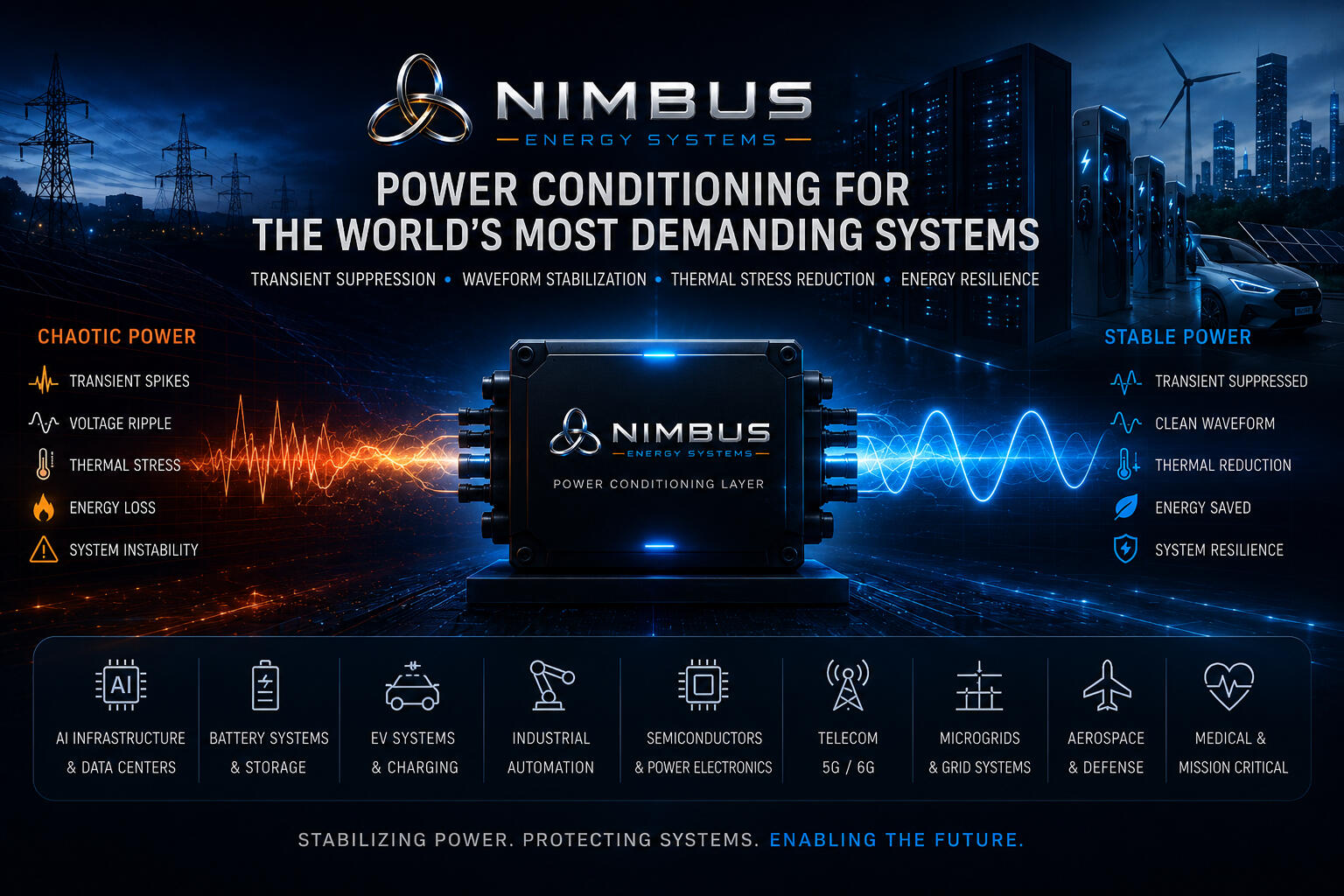
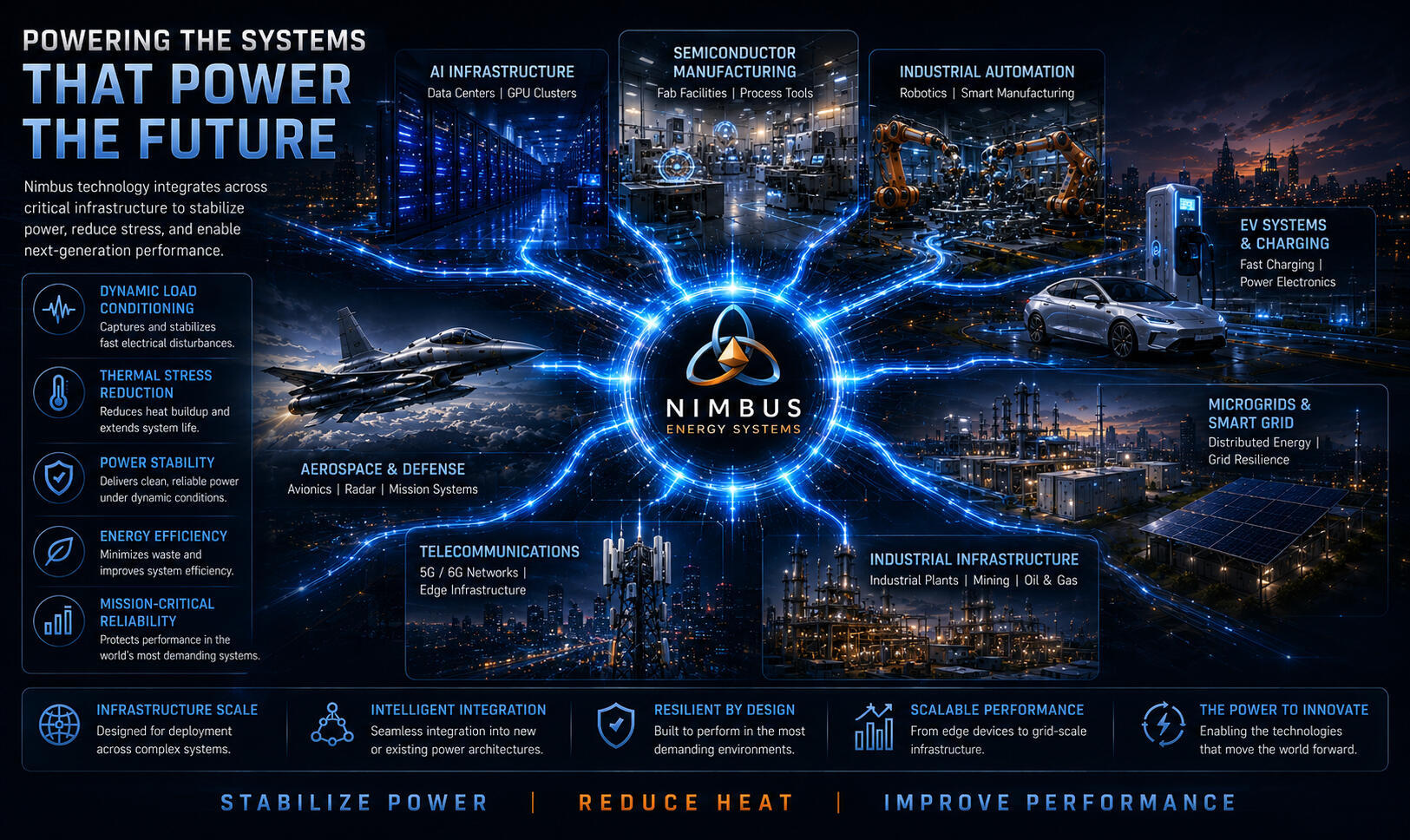
Supporting:AI infrastructure & data centers
Industrial automation
Robotics & autonomous systems
EV & battery-supported systems
Telecom infrastructure
Aerospace & defense
Semiconductors & power electronics
PLATFORM OVERVIEW
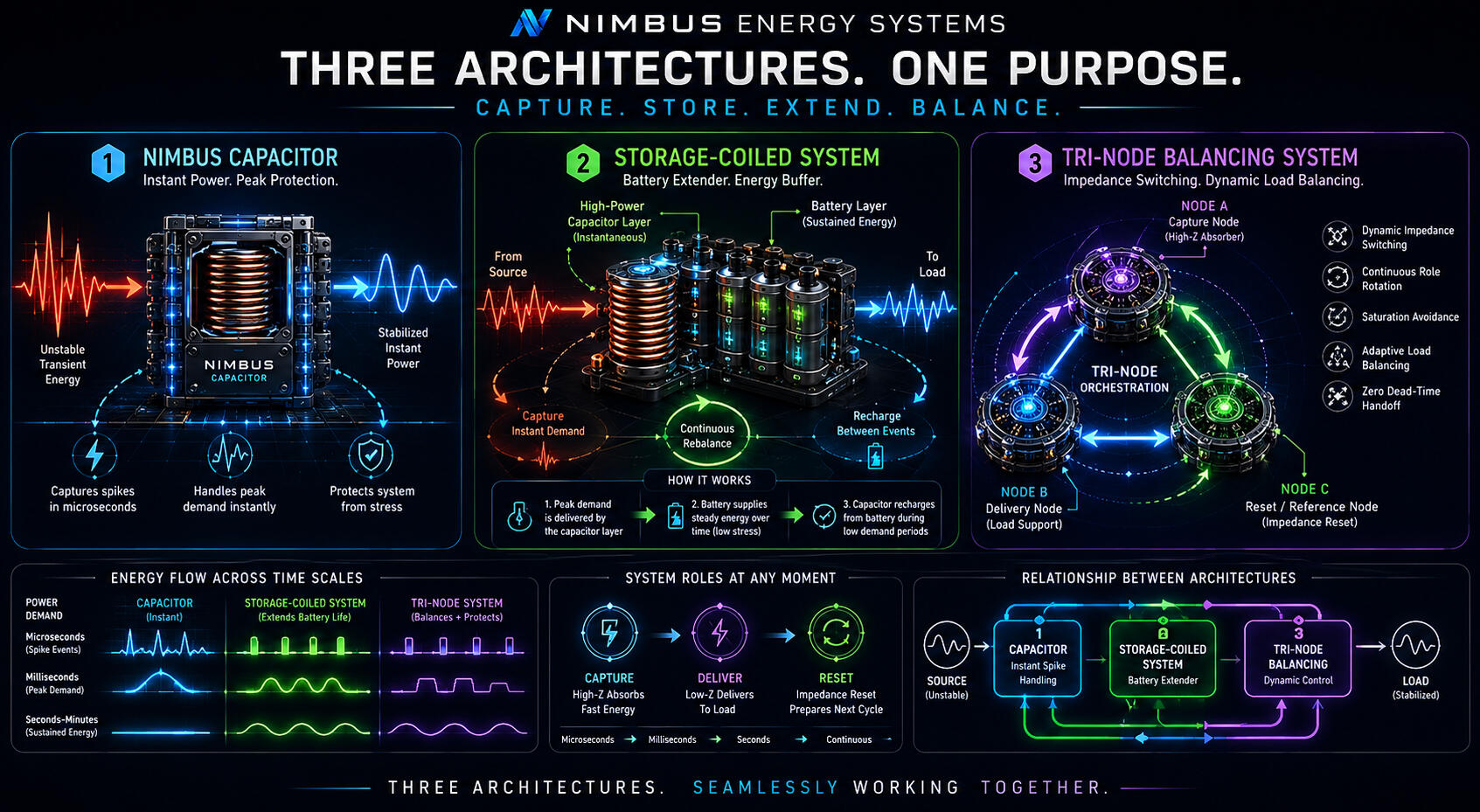
Three Architectures. One Purpose.Capture- > Store > Extend > Balance
Nimbus Energy Systems is developing a scalable family of power-conditioning architectures designed to manage fast electrical disturbances across multiple time scales.The platform is built around three core architectures:
ARCHITECTURE STACK
| Architecture | function |
|---|---|
| Nimbus Capacitor | Instant transient conditioning |
| Storage-Coiled System | Energy buffering and battery support |
| Tri-Node Orchestration | Dynamic routing and load balancing |
Each architecture addresses different layers of electrical instability while remaining modular and interoperable.
1. NIMBUS CAPACITOR
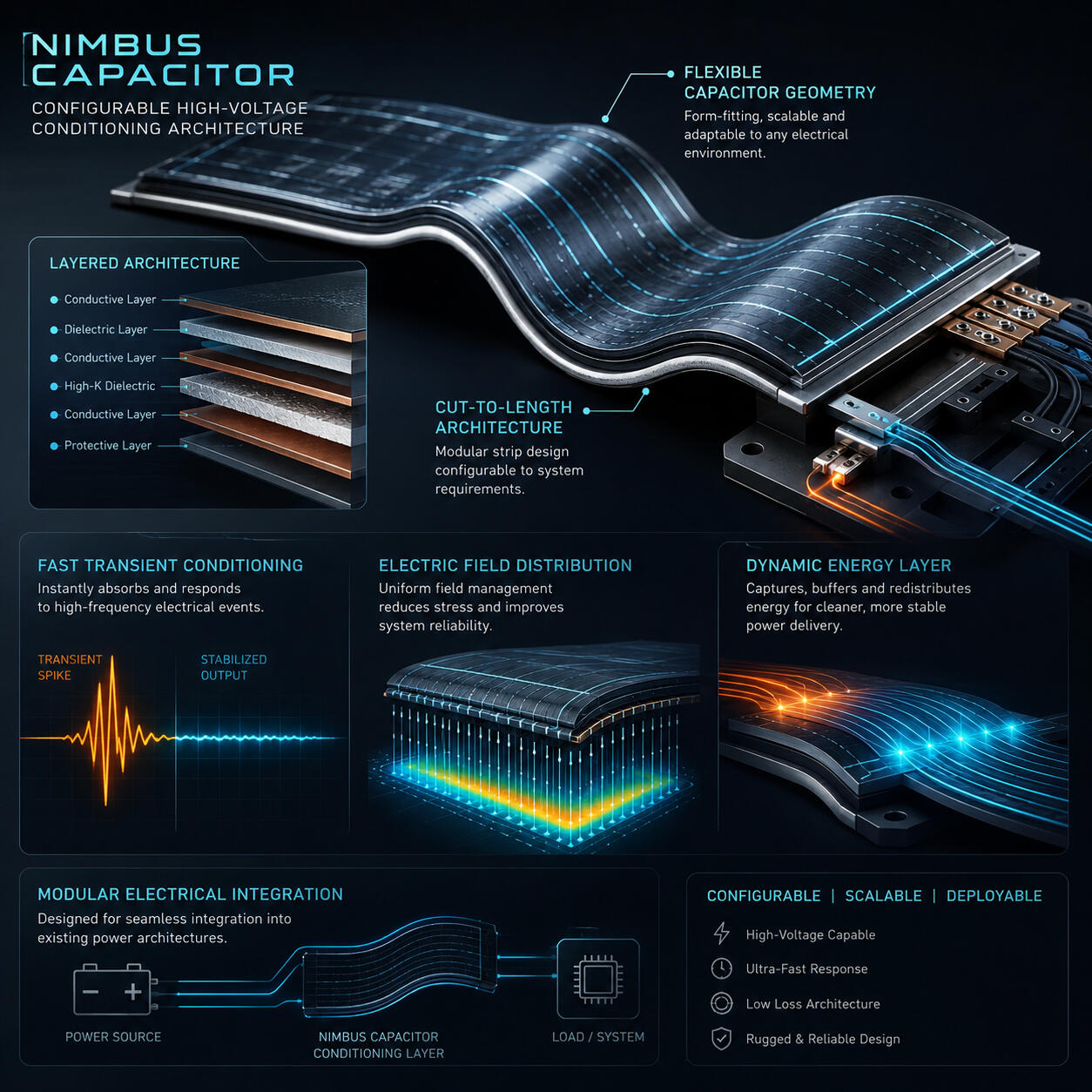
Instant transient conditioningA flexible, high-voltage capacitor architecture designed to absorb fast electrical spikes, stabilize voltage delivery, reduce reflected stress, and support clean power delivery during rapid load changes.
2. STORAGE-COILED SYSTEM
Energy buffering and battery supportA storage-coupled coil architecture designed to extend the usable energy behavior of the capacitor layer by adding sustained buffering, recharge behavior, and battery-supported delivery. This system helps separate instant peak demand from longer-duration energy supply.
3. TRI-NODE Dynamic routing and load balancing
Dynamic routing and load balancingA multi-node power-conditioning architecture designed to route, balance, and redistribute energy across active nodes. This architecture is being developed to manage impedance states, reduce local saturation, and support stabilized delivery under dynamic electrical conditions.
PRODUCT 1
The Nimbus Capacitor
Flexible High-Voltage Power Conditioning Architecture
What It Does
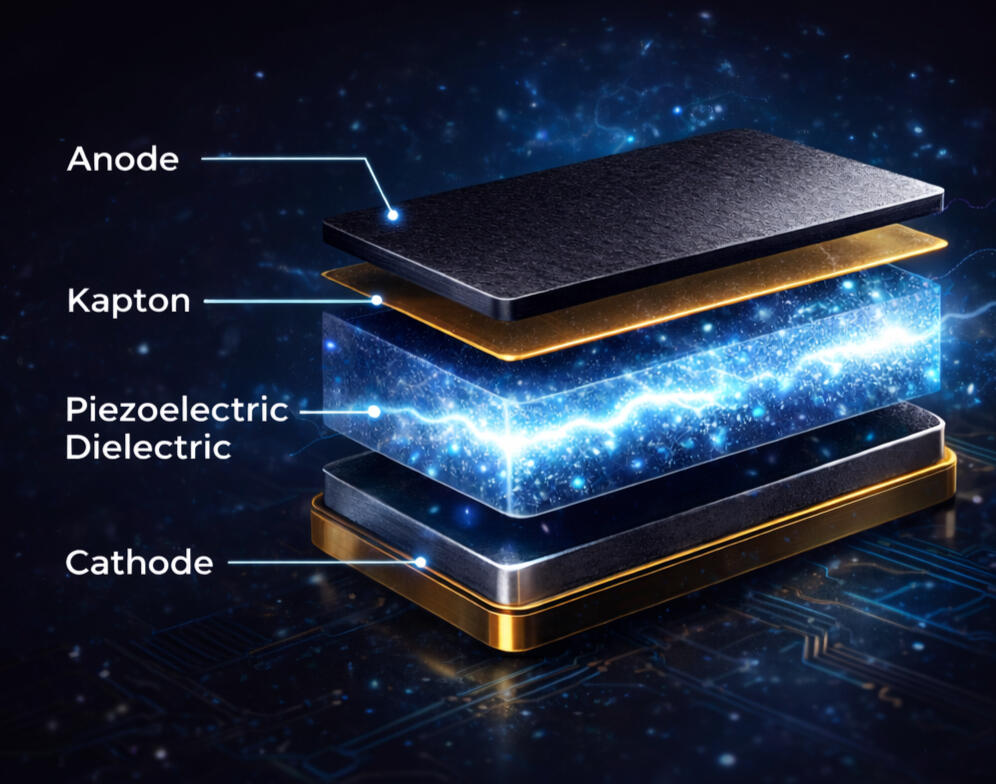
Nimbus Energy Systems has developed a flexible, high-voltage capacitor architecture designed for modern electrical environments where demand changes rapidly and conventional passive systems struggle to respond efficiently.Traditional capacitors are fixed components with limited adaptability.The Nimbus architecture is designed as a continuous, form-fitting energy layer that can be configured to match system requirements while supporting fast transient conditioning and dynamic electrical stabilization.
• absorbs and releases energy instantly
• stabilizes voltage during rapid load changes
• reduces heat generated from electrical inefficiencies
• smooths transient disturbances
• reduces reflected electrical stress
• stabilizes and optimizes power delivery
• helps protect sensitive electronics during dynamic switching events
Key Characteristics
• high-power energy buffer with fast discharge capability
• flexible and form-fitting geometry
• configurable capacitance through cut-to-length architecture
• high-voltage capable design
• modular integration into existing electrical layouts
• designed for dynamic electrical environments
Response Characteristics
The Nimbus Capacitor architecture operates across fast electrical response windows ranging from microseconds to milliseconds.This enables:• rapid transient absorption
• fast inline conditioning
• stabilization during dynamic load eventsUnlike conventional passive architectures that dissipate transient energy as heat, the Nimbus Capacitor is designed to condition fast electrical disturbances within the power environment.
Prototype Performance (Early Stage)
• approximately 1.0–1.4 nF per foot in flexible architecture format
• scalable through geometry and configuration changes
• configurable by length and deployment structureEarly subsystem testing demonstrates:• strong transient response behavior
• stable charge-discharge performance
• repeatable dynamic load conditioning characteristics
Current Validation Areas
• transient suppression
• voltage stabilization
• thermal reduction
• dynamic load response
• modular scaling
• inline conditioning deployment
Product 2:
Nimbus Storage-Coiled System
ENERGY BUFFERING AND EXTENDED POWER DELIVERY ARCHITECTURE
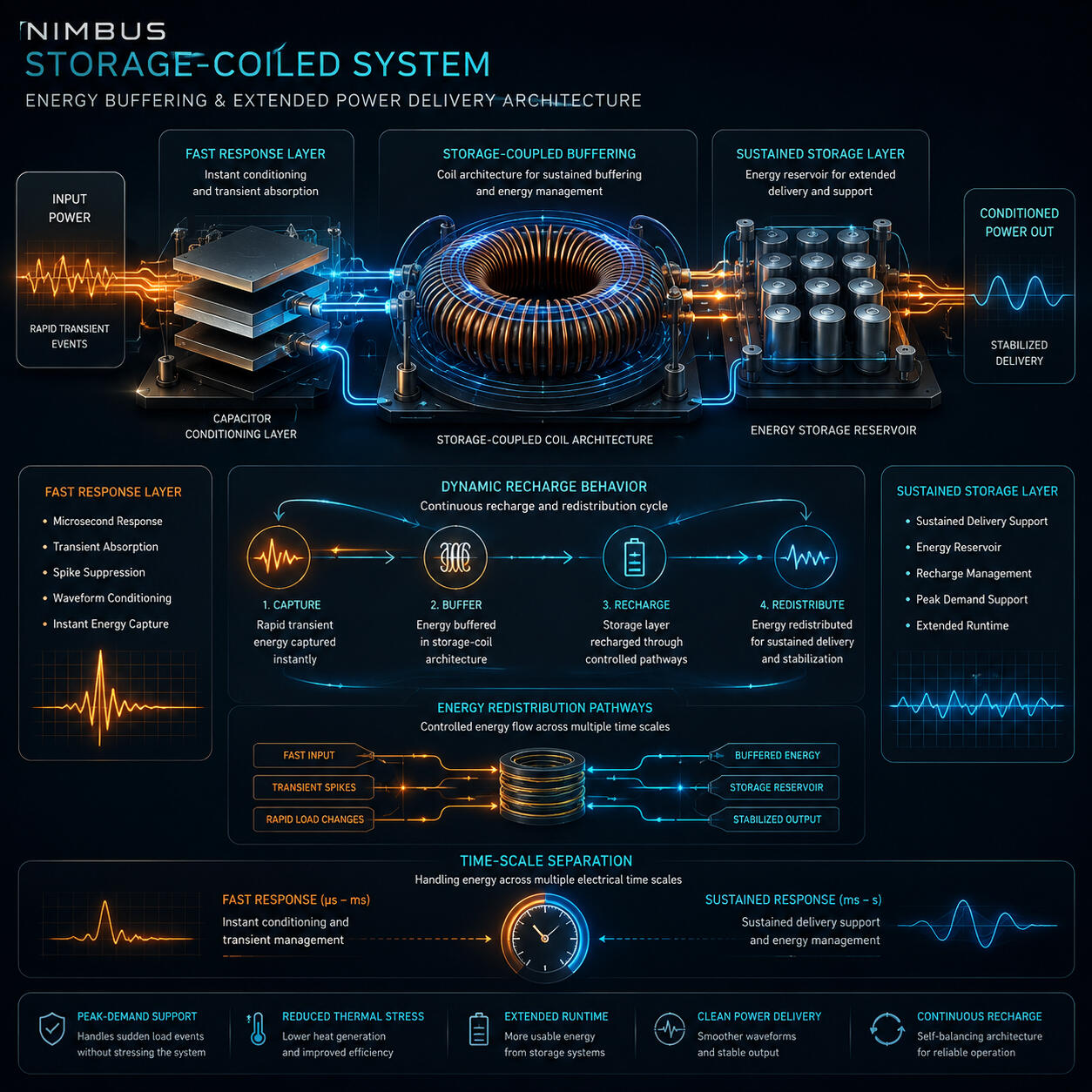
The Nimbus Storage-Coiled System expands beyond fast transient conditioning by introducing a storage-coupled coil architecture designed for sustained power support, energy redistribution, and dynamic load stabilization.Conventional electrical systems force batteries to handle both long-duration energy delivery and rapid peak-demand events simultaneously.These sudden load spikes generate:• thermal stress
• voltage instability
• accelerated degradation
• reduced efficiency
• increased electrical burden on the power systemThe Nimbus Storage-Coiled System separates these behaviors across multiple response layers.
HOW IT WORKS
The architecture combines:• fast-response capacitor conditioning
• storage-coupled coil geometries
• sustained energy buffering
• dynamic recharge behaviorThis enables the system to operate across multiple electrical time scales.
FAST-RESPONSE LAYER
Handles:• transient spikes
• rapid switching events
• short-duration peak demand
• fast electrical disturbances
• dynamic waveform instability
STORAGE-COUPLED LAYER
The storage-coupled layer provides:• sustained energy support
• recharge buffering
• stabilized long-duration delivery
• controlled discharge behavior
• extended runtime capabilityThe coil architecture continuously rebalances and redistributes energy during operation.
SYSTEM BENEFITS
• reduced battery stress
• lower thermal burden
• cleaner voltage delivery
• improved sustained performance
• stabilized power behavior under dynamic load
• support for peak-demand environments
• reduced electrical instability during switching eventsInstead of reacting passively to transient demand, the Nimbus Storage-Coiled System supports buffered delivery and controlled recharge behavior.
ARCHITECTURE CHARACTERISTICS
• storage-coupled coil geometry
• modular conditioning architecture
• sustained energy buffering
• dynamic recharge behavior
• inline power support capability
• scalable deployment structure
• designed for high-transient environments
CURRENT VALIDATION AREAS
• battery stress reduction
• thermal characterization
• dynamic load response
• sustained power delivery
• peak-demand buffering
• portable dynamic-load modules
Early subsystem testing demonstrates stable response behavior under dynamic electrical load conditions.
Product 3:
Nimbus Tri-Node Dynamic routing & load balancing
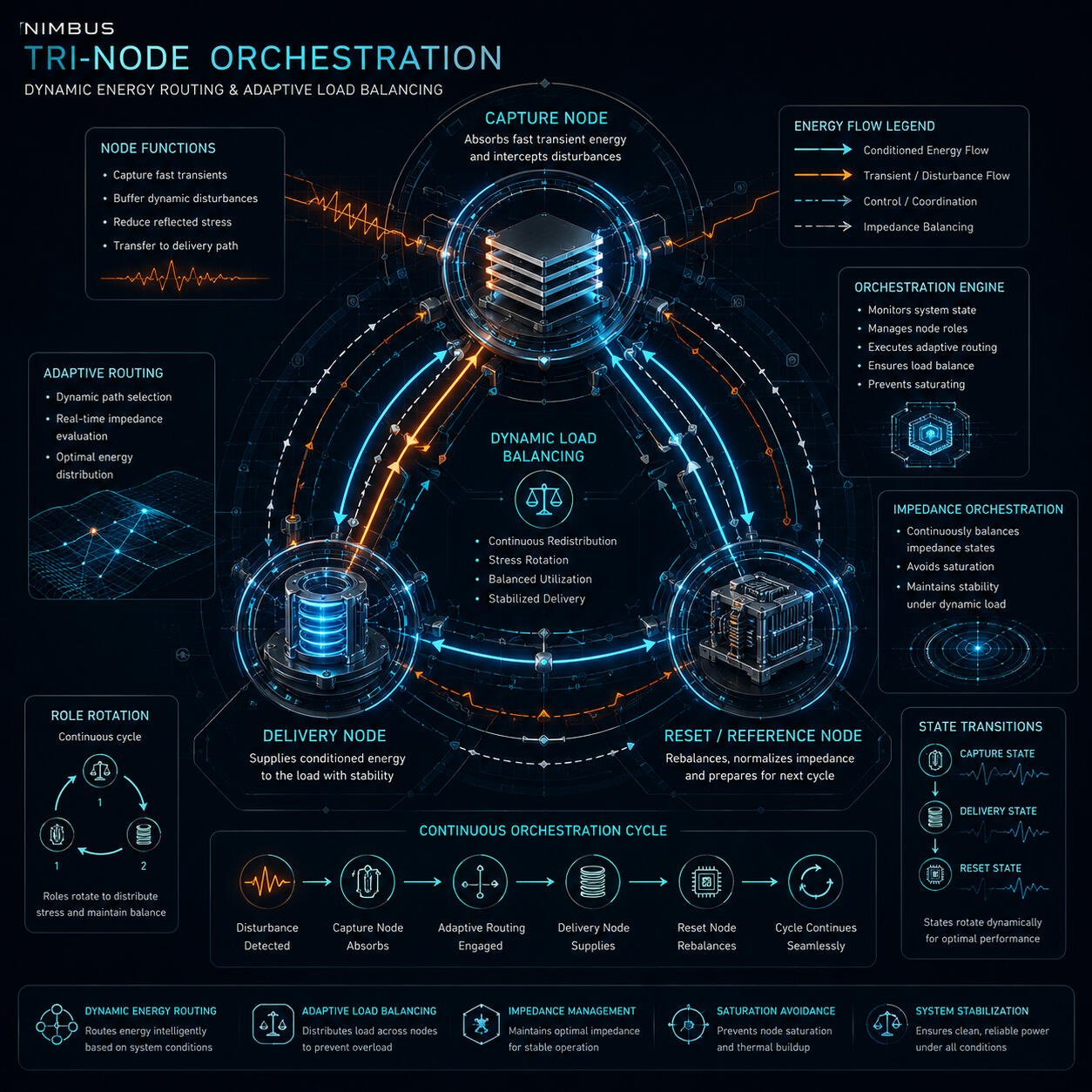
The Nimbus Tri-Node Orchestration architecture expands beyond standalone conditioning by introducing a multi-node electrical routing system designed to dynamically redistribute energy, balance load stress, and stabilize power delivery across complex electrical environments.Traditional electrical systems often rely on fixed pathways where individual components absorb repeated electrical stress during rapid load events.Over time this creates:• thermal accumulation
• voltage instability
• localized electrical stress
• saturation effects
• reduced efficiency under dynamic demandThe Nimbus Tri-Node architecture is designed to continuously redistribute these electrical demands across multiple active nodes.
HOW IT WORKS
| node | function |
|---|---|
| Capture Node | Absorbs fast transient energy |
| Delivery Node | Supplies conditioned energy to load |
| Reset / Reference Node | Rebalances and prepares next cycle |
These nodes continuously rotate operational roles during runtime.This architecture enables:• adaptive impedance routing
• dynamic load balancing
• saturation avoidance
• stabilized power delivery under changing demand conditions
CAPTURE NODE
The Capture Node is responsible for:• absorbing fast transient energy
• intercepting rapid electrical spikes
• buffering dynamic disturbances
• reducing reflected electrical stressThis node operates as the fast-response intake layer during rapid load events.
DELIVERY NODE
The Delivery Node provides:• conditioned energy delivery
• stabilized voltage support
• controlled output behavior
• dynamic power redistribution to the loadThis node supplies usable conditioned energy back into the system during operation.
RESET / REFERENCE NODE
The Reset / Reference Node enables:• system rebalancing
• node recovery behavior
• impedance normalization
• preparation for the next operating cycleThis allows the architecture to continuously rotate operational stress rather than concentrating demand in a single pathway.
SYSTEM BENEFITS
• dynamic load balancing
• reduced localized stress
• stabilized delivery behavior
• improved transient handling
• reduced thermal accumulation
• adaptive impedance management
• improved sustained electrical stability
ARCHITECTURE CHARACTERISTICS
• multi-node conditioning topology
• adaptive routing architecture
• dynamic impedance balancing
• modular orchestration layers
• scalable deployment structure
• designed for high-transient environments
CURRENT VALIDATION AREAS
• impedance-routing behavior
• transient redistribution
• node balancing response
• dynamic load conditioning
• sustained stability under switching events
• adaptive routing behavior
• modular orchestration testing
Current development is focused on controlled subsystem validation, dynamic load testing, and scalable orchestration architectures for high-performance electrical environments.
TRADITIONAL SYSTEMS VS NIMBUS
CONVENTIONAL ELECTRICAL SYSTEMS WERE DESIGNED FOR STEADY-STATE OPERATION.
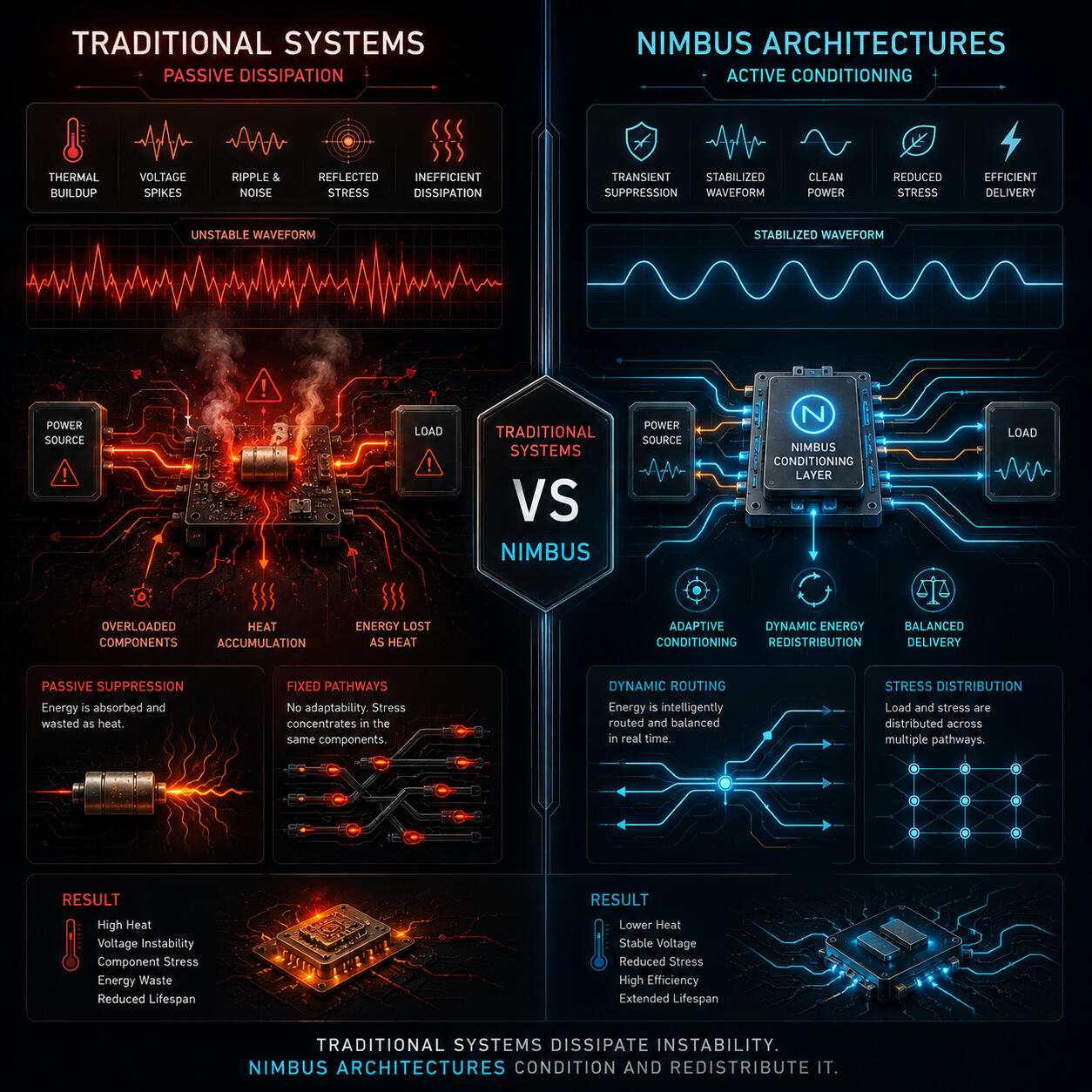
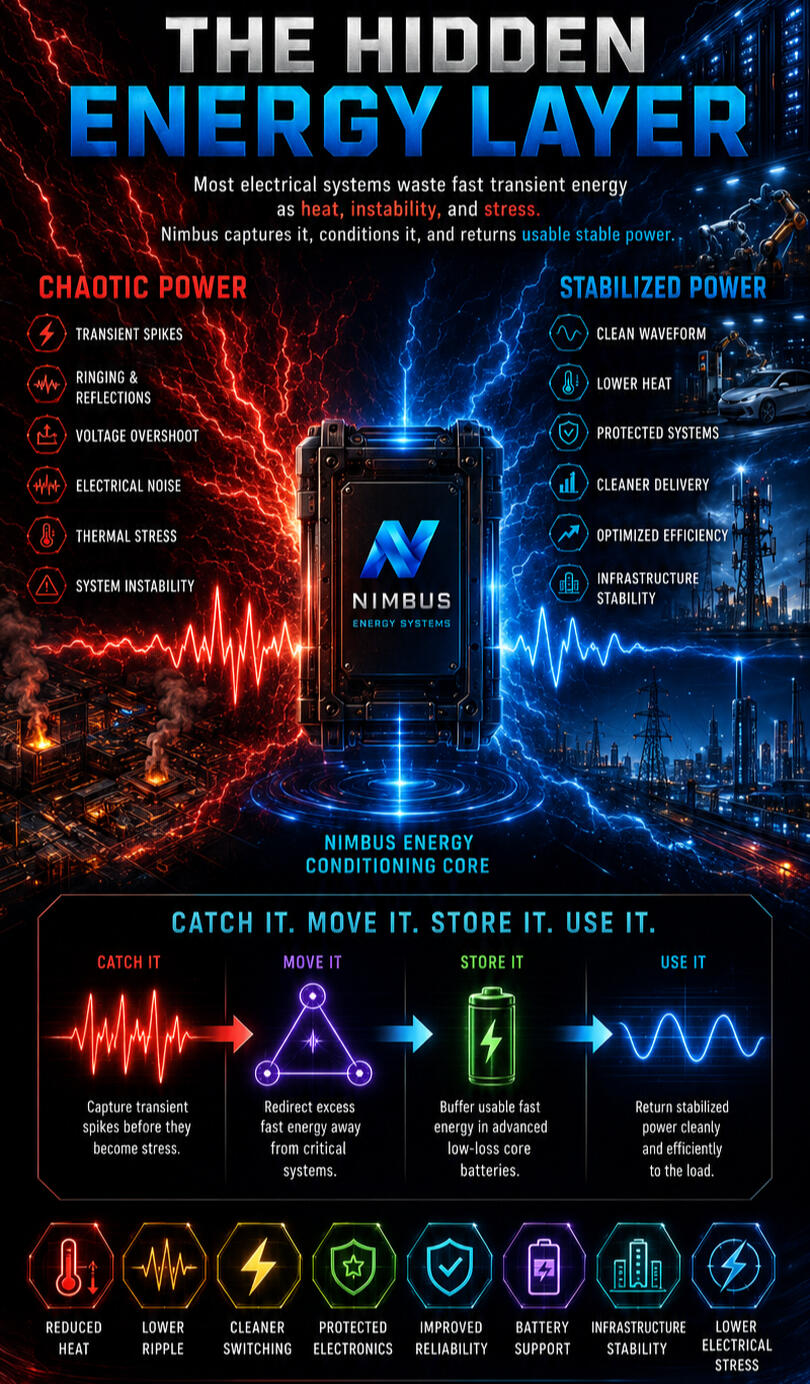
AI infrastructure, industrial automation, robotics, electrification systems, and high-speed switching environments create rapid and unpredictable changes in electrical demand.These dynamic load events generate:• transient spikes
• voltage instability
• ripple
• reflected electrical stress
• thermal buildup
• reduced efficiency
• accelerated component degradation
TRADITIONAL APPROACH
Conventional architectures often rely on:• fixed capacitors
• resistive suppression
• static filtering layers
• oversized cooling systems
• passive thermal managementAs electrical demand increases, these systems experience:• rising thermal stress
• reduced efficiency under dynamic load
• power instability during switching events
• increased cooling requirements
• accelerated hardware wear
THE NIMBUS APPROACH
Nimbus architectures are designed to actively condition fast electrical behavior before instability propagates through the system.Rather than operating as fixed passive components, Nimbus systems are designed to:• absorb transient disturbances
• stabilize dynamic power delivery
• redistribute fast electrical events
• reduce reflected stress
• buffer peak demand conditions
• support sustained operation under changing loadsThis enables electrical systems to operate more efficiently under dynamic real-world conditions.
KEY DIFFERENCES
TRADITIONAL SYSTEMS• passive suppression
• localized stress accumulation
• thermal-heavy operation
• fixed electrical pathways
• transient energy dissipated as heat
• limited adaptability under changing demandNIMBUS ARCHITECTURES• active power conditioning
• stabilized voltage delivery
• adaptive routing behavior
• reduced thermal burden
• modular conditioning layers
• designed for unstable power conditions
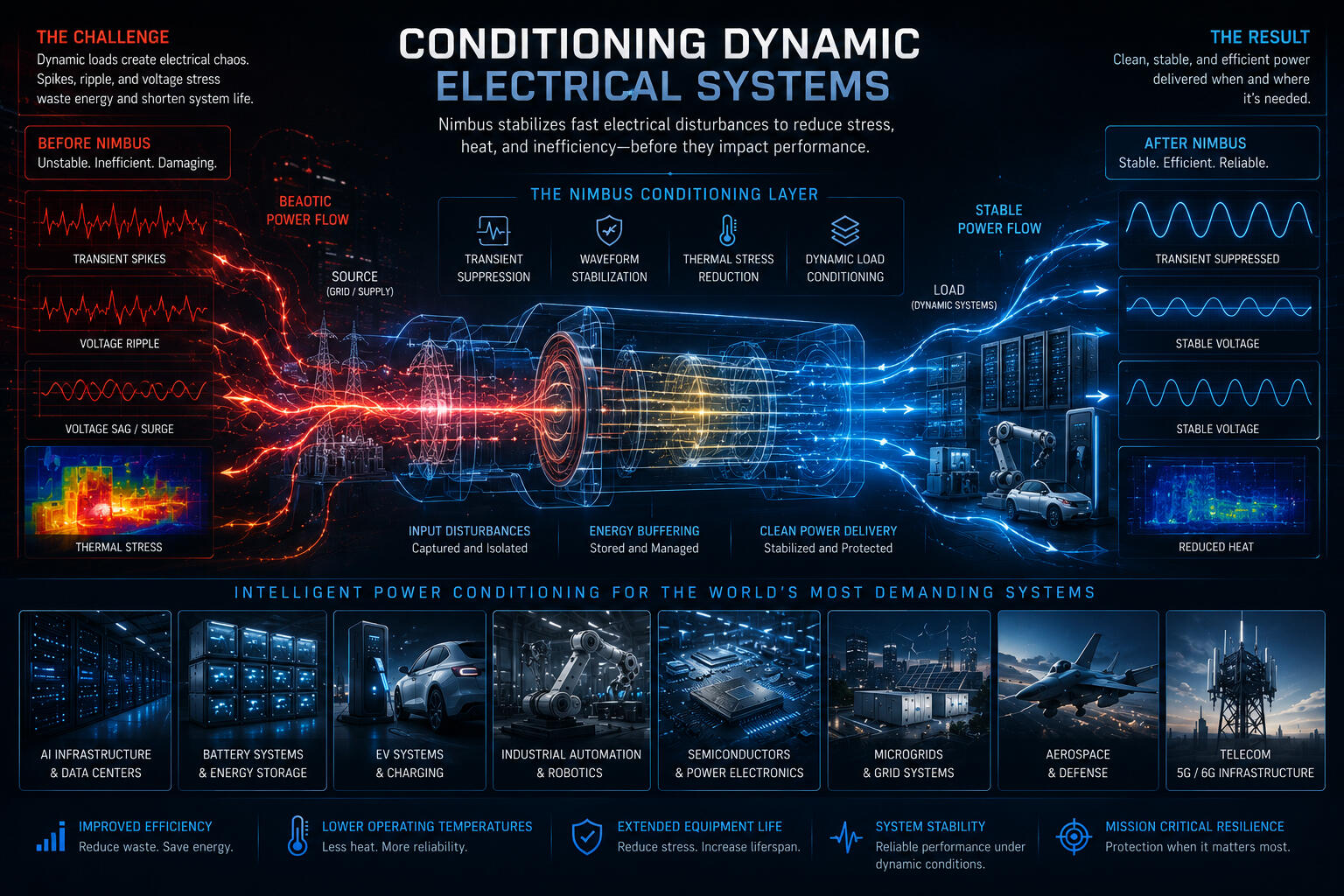
The objective is not simply to store energy, but to manage how electrical energy behaves throughout the system.
Validation and Dynamic Load Testing
CONTROLLED SUBSYSTEM VALIDATION FOR MODERN POWER ENVIRONMENTS
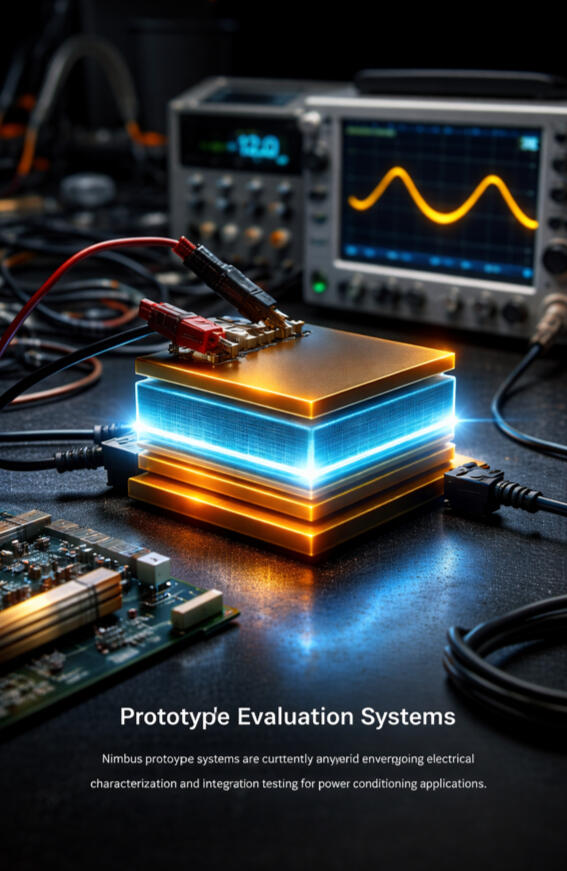
Nimbus Energy Systems is advancing through controlled subsystem testing focused on transient conditioning, dynamic load behavior, thermal reduction, and stabilized power delivery under rapidly changing electrical conditions.The objective is to evaluate how the Nimbus architectures respond during real-world electrical stress events rather than only steady-state operation.
CURRENT VALIDATION FOCUS
Testing is currently focused on:• transient spike suppression
• waveform stabilization
• dynamic load response
• thermal characterization
• sustained delivery behavior
• reflected stress reduction
• ripple reduction
• energy buffering behavior
• impedance-routing response
• modular scaling architectures
ACTIVE TEST PLATFORMS
Current subsystem validation includes portable high-transient tool modules, capacitor architectures, storage-coupled systems, and dynamic orchestration platforms operating under repetitive switching and pulse-load conditions.Current experimental platforms include:• folded capacitor architectures
• flexible capacitor layers
• storage-coupled coil systems
• battery-assisted buffering systems
• tri-node routing architectures
• portable dynamic-load platforms
• high-transient tool modules
DYNAMIC LOAD TESTING
Nimbus architectures are being evaluated under rapidly changing electrical demand conditions designed to simulate real-world power environments.Testing environments include:• pulse-loading events
• switching disturbances
• transient-heavy operation
• repetitive dynamic cycling
• variable electrical demand conditions
• sustained peak-load scenariosThe focus is to observe how the architectures condition, redistribute, and stabilize electrical behavior during fast load transitions.
VALIDATION METHODS
Testing and characterization methods include:• oscilloscope waveform analysis
• before-and-after transient comparisons
• ripple and overshoot observation
• thermal monitoring
• controlled discharge analysis
• dynamic switching evaluation
• modular configuration testing
• comparative load-response studies
CURRENT DEVELOPMENT AREAS
• inline transient conditioning
• storage-coupled energy buffering
• dynamic impedance management
• load-balancing architectures
• sustained power support systems
• modular deployment structures
• scalable conditioning layers
PORTABLE MODULE VALIDATION
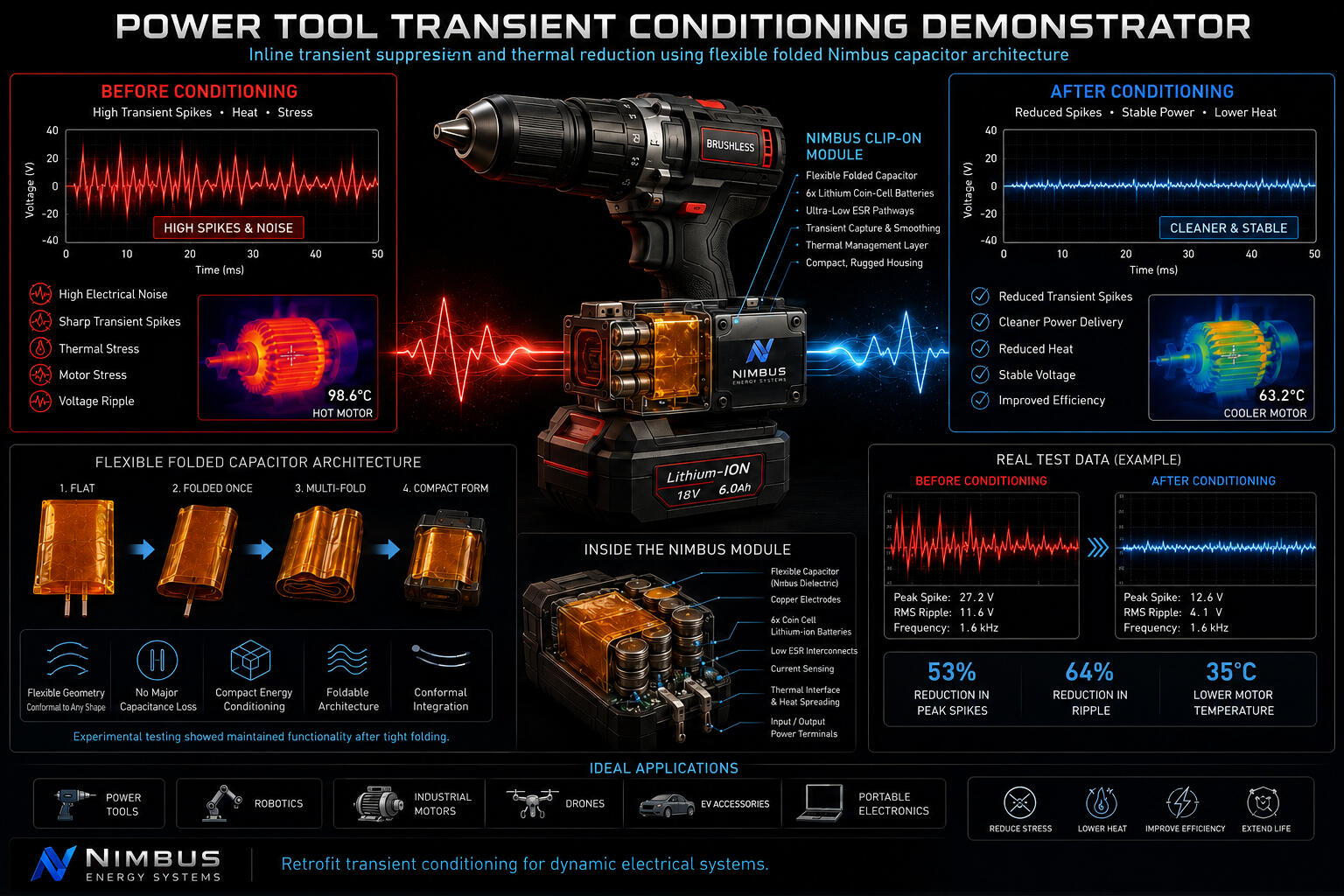
Current subsystem development includes portable high-transient load platforms designed to evaluate conditioning behavior under demanding real-world operation.These platforms are being used to study:• peak-demand support
• transient reduction behavior
• thermal response
• sustained delivery performance
• repeatable dynamic load handling
DEVELOPMENT APPROACH
Nimbus follows an iterative subsystem validation approach focused on:• controlled comparative testing
• repeatability
• modular scalability
• measurable electrical behavior
• deployment-oriented architecturesThe goal is to progressively advance the platform from subsystem validation toward pilot-ready conditioning architectures for high-demand electrical systems.
Deployment Pathways
BUILT FOR REAL-WORLD ELECTRICAL SYSTEMS
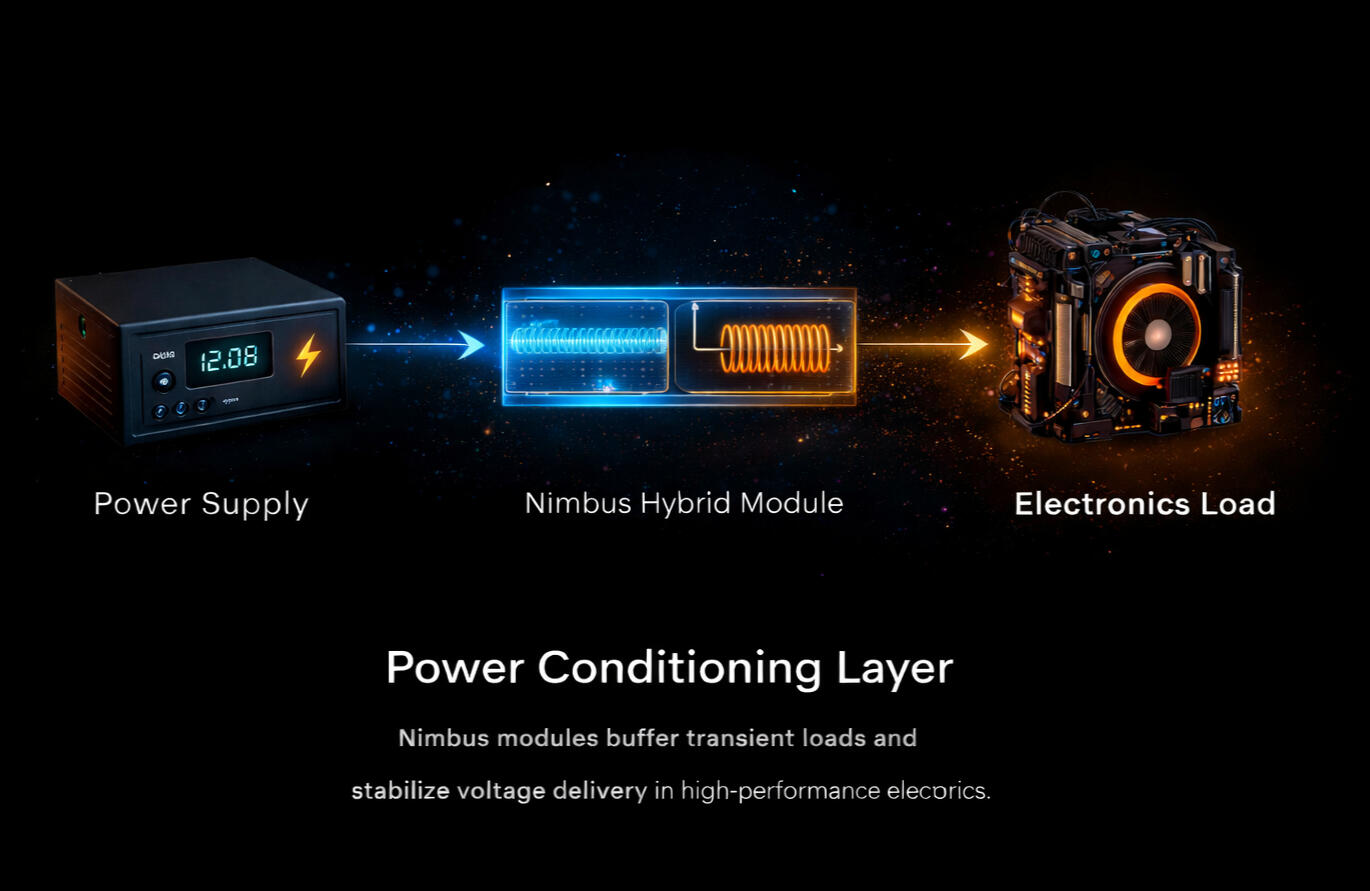
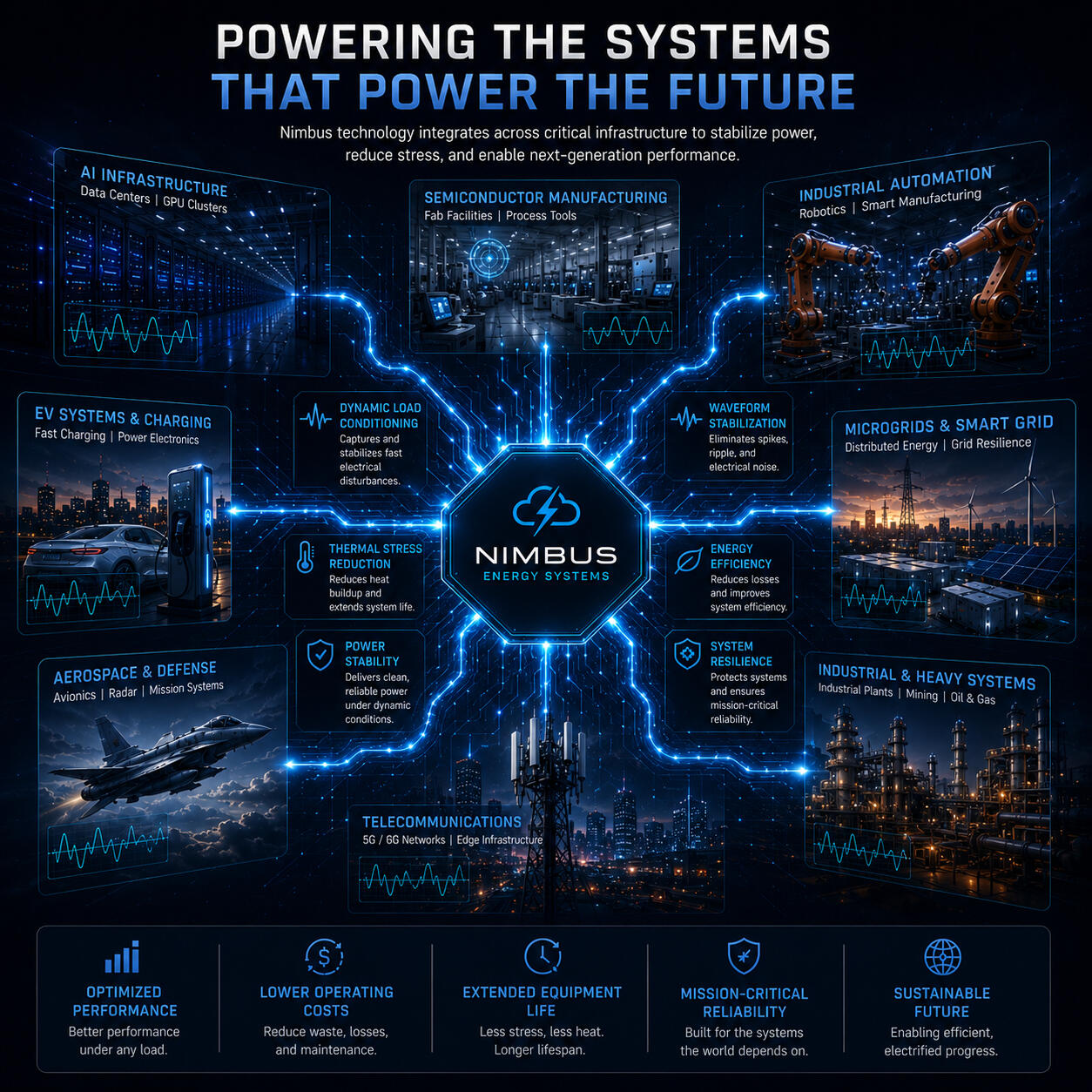
Nimbus Energy Systems is developing modular power-conditioning architectures designed for integration across a wide range of transient-heavy operationThe platform is intended to scale from compact inline conditioning modules to larger distributed orchestration systems depending on application requirements.
POTENTIAL APPLICATION AREAS
• AI infrastructure / data centers
• Server and high-performance computing systems
• Industrial automation
• Robotics and autonomous systems
• EV systems
• Telecom / 5G / 6G infrastructure
• Battery-supported systems
• Grid and microgrid systems
• Edge compute environments
• Aerospace and defense systems
• Semiconductors / power electronics
• Advanced electronics
• Resilient infrastructure platforms
MODULAR DEPLOYMENT APPROACH
The Nimbus platform is being developed across multiple deployment layers:• inline transient conditioning
• storage-coupled buffering systems
• battery-assisted stabilization layers
• dynamic routing architectures
• distributed orchestration systemsThis modular approach allows different architectures to be integrated independently or combined into larger conditioning environments.
INFRASTRUCTURE SCALABILITY
The Nimbus platform is designed around scalable deployment pathways ranging from localized conditioning modules to larger distributed power architectures.Potential deployment structures include:• inline retrofit conditioning
• subsystem-level buffering
• distributed node balancing
• infrastructure-scale orchestration
• battery-supported stabilization layers
• dynamic impedance-routing systems
DESIGN PHILOSOPHY
Rather than replacing existing electrical infrastructure, Nimbus is being developed as a conditioning and stabilization layer that can operate alongside existing systems.The objective is to improve how electrical energy is managed during dynamic operating conditions.This includes:• reducing transient burden
• lowering thermal stress
• stabilizing delivery behavior
• improving sustained operation
• supporting sensitive electronics
• enabling cleaner dynamic power environments
CURRENT DEVELOPMENT DIRECTION
Current platform development is focused on:• modular subsystem integration
• scalable conditioning architectures
• portable validation platforms
• deployment-oriented testing
• pilot-ready system pathways
• dynamic infrastructure applicationsThe long-term objective is to enable adaptable power-conditioning architectures capable of operating across increasingly demanding electrical environments.
Technology Development Status
ADVANCING MODULAR POWER-CONDITIONING ARCHITECTURES
Nimbus Energy Systems is currently progressing through controlled subsystem validation focused on transient conditioning, energy buffering, dynamic load stabilization, and scalable power-routing architectures.The platform is being developed through an iterative engineering and validation process designed to advance from early subsystem characterization toward pilot-ready deployment pathways.
NIMBUS CAPACITOR
STATUS:
Prototype validation underwayCURRENT FOCUS:• transient suppression
• waveform stabilization
• reflected stress reduction
• fast-response conditioning
• flexible capacitor geometries
• modular scaling architecturesCURRENT VALIDATION:• dynamic load testing
• charge-discharge characterization
• transient response behavior
• inline conditioning evaluation
• waveform observation under switching events
STORAGE-COILED SYSTEM
STATUS:
Advancing through subsystem integration and dynamic load testingCURRENT FOCUS:• sustained energy buffering
• battery-assisted support behavior
• thermal reduction
• dynamic recharge response
• peak-demand stabilization
• storage-coupled conditioning architecturesCURRENT VALIDATION:• dynamic load evaluation
• sustained delivery observation
• battery stress reduction studies
• transient redistribution behavior
• portable high-transient platforms
TRI-NODE ORCHESTRATION
STATUS:
Architecture and routing-layer development in progressCURRENT FOCUS:• adaptive impedance routing
• node-balancing behavior
• dynamic energy redistribution
• saturation avoidance
• modular orchestration structures
• scalable power-routing systemsCURRENT VALIDATION:• transient-routing observation
• impedance-balancing studies
• dynamic switching evaluation
• multi-node conditioning architectures
PORTABLE VALIDATION MODULES
STATUS:
TRL 6 portable subsystem demonstration pathway underwayCurrent portable module development is focused on evaluating Nimbus conditioning architectures within high-transient handheld electrical environments.These systems are being used to study:• rapid peak-demand response
• transient suppression behavior
• sustained delivery support
• thermal response characteristics
• repeatable dynamic load handling
DEVELOPMENT DIRECTION
Nimbus is being developed as a modular power-conditioning platform capable of operating across multiple electrical environments ranging from inline conditioning layers to larger distributed orchestration architectures.The current objective is to advance toward scalable pilot-ready deployment systems designed for modern dynamic electrical infrastructure.
Pilot & Evaluation Program
EXPLORING REAL-WORLD VALIDATION PARTNERSHIPS
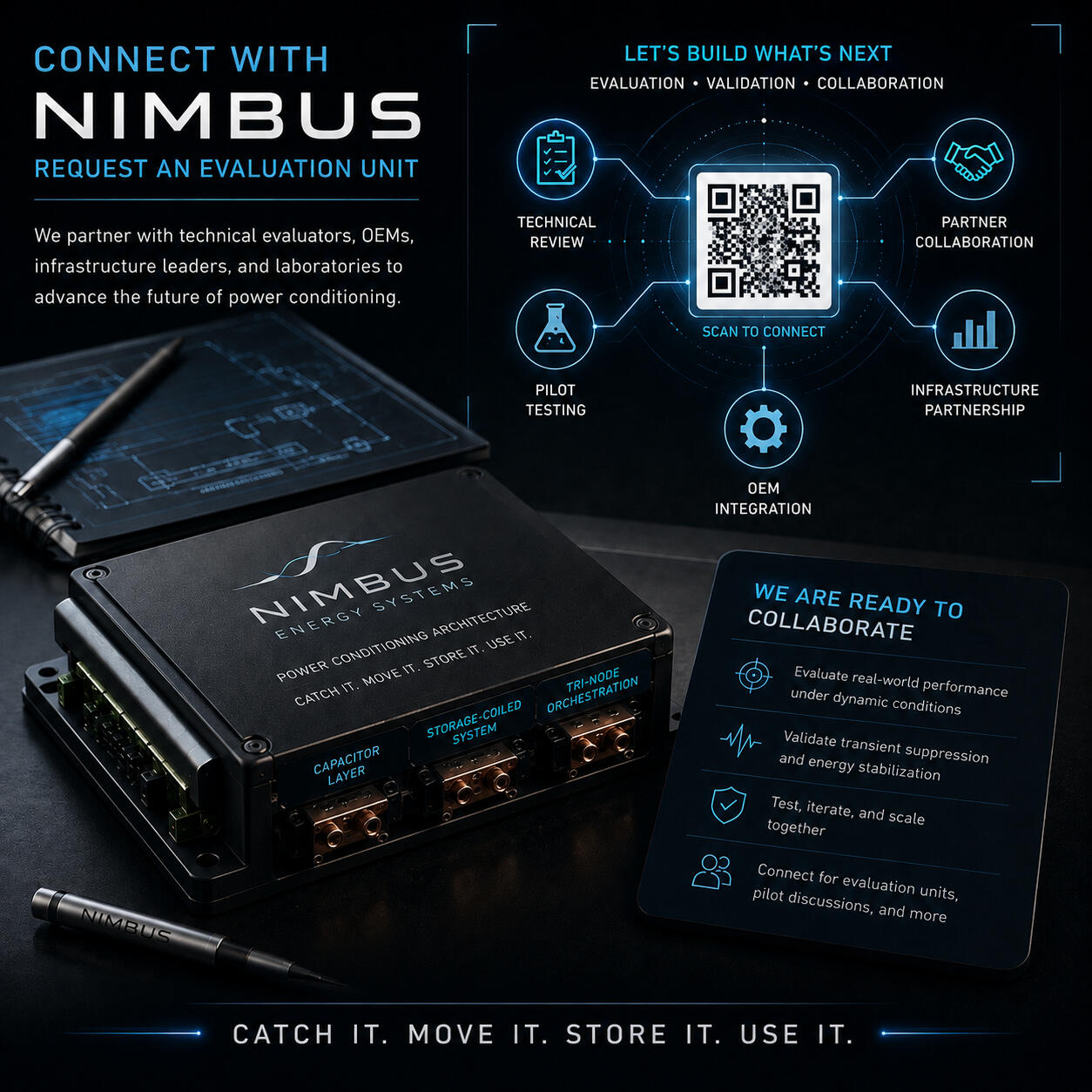
Nimbus Energy Systems is currently pursuing pilot evaluation opportunities and technical review partnerships focused on dynamic electrical environments where transient behavior, thermal stress, and power instability create operational challenges.The objective is to advance the platform through deployment-oriented subsystem validation and application-specific testing.
PILOT PROGRAM FOCUS
Pilot and evaluation activities are currently centered around:• transient suppression evaluation
• waveform stabilization behavior
• dynamic load conditioning
• thermal response characterization
• sustained delivery support
• modular deployment validation
• infrastructure integration pathways
TARGET PARTNERSHIPS
Nimbus is interested in connecting with organizations involved in:• AI infrastructure
• industrial automation
• robotics systems
• telecom infrastructure
• electrification systems
• battery-supported environments
• advanced manufacturing
• aerospace and defense systems
• resilient infrastructure platforms
COLLABORATION INTERESTS
Nimbus is currently open to discussions involving:• pilot evaluations
• subsystem demonstrations
• technical review partnerships
• commercialization discussions
• infrastructure validation programs
• deployment pathway exploration
• research collaborations
• OEM integration opportunities
Contact & Resources
Request Evaluation / Technical Discussion /Pilot Discussion
Nimbus Energy Systems is currently engaging with technical evaluators, OEMs, infrastructure partners, pilot programs, and organizations interested in dynamic power-conditioning architectures.
Current discussion areas include:• transient suppression evaluation
• dynamic load testing
• battery-supported environments
• infrastructure stabilization
• subsystem demonstrations
• pilot validation pathways
• OEM integration discussions
• technical review opportunities
Direct ContactJoshua
Founder & CEO
Nimbus Energy Systems
587-573-9171Email: [email protected]